You Have Believed.
What Now?
The beginning of your life as a child of God.
“For ye are all the children of God by faith in Christ Jesus.”
You have begun.
This guide is written for the person who has believed on Jesus Christ as Saviour and now asks, “What comes next?” It is a guide to the beginning of Christian life—not twelve more requirements to become saved.
Scripture makes the order clear: a person becomes a child of God by faith in Christ Jesus (Galatians 3:26). After that comes learning, obedience, fellowship, service, and growth. Those things are important, but they are not another payment for the gift of eternal life.
The goal is not to overwhelm you with religious instructions. It is to show what the Bible says, explain why each truth matters, and give you a small, practical step to begin.
Growing in Christ.
What happened when you believed?
“For ye are all the children of God by faith in Christ Jesus.”
Galatians 3:26 · KJV
Begin with what God has said, not simply what you feel. Galatians 3 explains that the law does not make a sinner righteous. Paul then declares how believers are God’s children: “by faith in Christ Jesus.” But what does it mean to believe on Jesus Christ? That question deserves more than a quick slogan.
Not merely knowing.
Trusting Christ.
Someone may know that Jesus died and rose again, repeat familiar Bible verses, and say, “I believe in Jesus,” yet still be trusting his own goodness, baptism, or religious efforts to get to heaven. Knowing facts about the Saviour is not the same as relying on the Saviour.
The Gospel is the good news that Christ died for our sins, was buried, and rose again (1 Corinthians 15:3–4). Biblical faith is not an empty sound made by the lips. It is receiving God’s testimony concerning His Son and placing your confidence in Jesus Christ Himself as the One able to save you.
“That if thou shalt confess with thy mouth the Lord Jesus, and shalt believe in thine heart that God hath raised him from the dead, thou shalt be saved. For with the heart man believeth unto righteousness; and with the mouth confession is made unto salvation.”
Romans 10:9–10 · KJV
Read Romans 10:8–13 in context. Paul is speaking about the righteousness which is of faith, not giving a new list of religious works by which someone may purchase salvation. His words “believe in thine heart” distinguish genuine inward belief from merely repeating religious language. Confessing Jesus as Lord expresses the faith Paul describes; it is not a payment added to Christ’s saving work.
“Heart” does not mean you must manufacture an overwhelming feeling, reach a particular emotional intensity, or prove that you have no questions. It points to real, personal belief rather than words spoken without trust. The object of faith matters: the Lord Jesus Christ, whom God raised from the dead.
“In whom ye also trusted, after that ye heard the word of truth, the gospel of your salvation: in whom also after that ye believed, ye were sealed with that holy Spirit of promise,”
Ephesians 1:13 · KJV
Notice Paul’s words: heard the word of truth, trusted, believed, and were sealed. The Ephesians heard the Gospel of their salvation and placed their trust in Christ. God then describes them as sealed with the Holy Spirit of promise. Paul does not say they first had to earn that standing through years of obedience. We will examine the Spirit’s sealing further in Lesson 3.
Consider Paul’s own testimony: “I know whom I have believed, and am persuaded that he is able to keep that which I have committed unto him against that day” (2 Timothy 1:12). His confidence was not in the strength of his feelings but in the One whom he trusted. Likewise, Abraham was “fully persuaded” that God could do what He had promised (Romans 4:21). Those passages illustrate confidence in God’s faithfulness; they do not make perfect certainty or the absence of every doubt an additional requirement for salvation.
Faith cannot be forced by pressure from a preacher, a parent, or a crowd. Someone else cannot trust Christ on your behalf. A repeated sentence or a prayer may express belief, but the act of repeating words does not replace belief. God calls the hearer to believe His Word concerning His Son.
John 1:12 brings receiving Christ and believing on His name together. Receiving Him is not a separate ceremony to perform after believing. The passage speaks of those who believe on Him becoming sons of God. Your standing is not created by church attendance, baptism, a changed personality, or faithful service.
A child must learn to walk, speak, obey, and mature; none of those activities makes the child a member of the family. Likewise, Christian growth follows the new relationship; it does not buy that relationship. This difference will protect you from much confusion later.
Faith in Jesus Christ.
The issue is not whether you can say the words “I believe.” The question is whom you are trusting to save you. According to Galatians 3:26, God’s children are His children by faith in Christ Jesus.
Read Romans 10:8–13, Ephesians 1:12–14, John 1:12–13, and Galatians 3:21–29. Ask yourself: Am I relying on what Jesus Christ has done, or am I still relying on something I must do?
Without Christ.
In Christ.
The Bible does not use child of God, child of light, or new creature as titles earned by good behaviour. These describe a person’s relationship to Christ. Scripture also describes the condition of those who have not believed.
Without the Son.
“He that believeth on the Son hath everlasting life: and he that believeth not the Son shall not see life; but the wrath of God abideth on him.”
John 3:36 · KJV
The distinction is not between people who do many religious deeds and people who do few. John makes the issue belief on the Son. One who does not believe remains under the wrath of God.
Ephesians 2:1–3 recalls the former condition of people who later became believers. Paul says they “were by nature the children of wrath” (Ephesians 2:3). He speaks of what they were before God’s saving work.
In Christ.
“For ye are all the children of God by faith in Christ Jesus.”
Galatians 3:26 · KJV
The believer is a child of God by faith, not through years of religious performance (John 1:12–13). Believers are also called “the children of light” (1 Thessalonians 5:5), and Paul says of the person in Christ that “he is a new creature” (2 Corinthians 5:17).
These truths describe the believer’s new standing. The instruction to “walk as children of light” in Ephesians 5:8 comes after Paul’s statement that they are now light in the Lord.
“None of his.”
What does Paul mean?
“But ye are not in the flesh, but in the Spirit, if so be that the Spirit of God dwell in you. Now if any man have not the Spirit of Christ, he is none of his.”
Romans 8:9 · KJV
Romans 8:5–9 contrasts those who are in the flesh with those who are in the Spirit. Paul says in verse 8 that those who are in the flesh cannot please God. Then he addresses believers: “But ye are not in the flesh, but in the Spirit, if so be that the Spirit of God dwell in you.”
His final statement is unmistakable: “Now if any man have not the Spirit of Christ, he is none of his.” To be none of his means not to belong to Jesus Christ. Paul is speaking about a person’s relationship to Christ, not assigning a reward for religious activity.
a person is none of His.
This is not a test of whether someone has achieved a sinless life. The Spirit’s indwelling marks a person who belongs to Christ. Ephesians 1:13 says that those who heard the Gospel, trusted Christ, and believed were sealed with the Holy Spirit. Galatians 4:6 says, “And because ye are sons, God hath sent forth the Spirit of his Son into your hearts, crying, Abba, Father.”
The order matters. A person does not live faithfully for years to earn the Spirit. Nor does an impressive religious life make an unbeliever Christ’s own. Belonging to Christ comes first; walking faithfully as His child follows.
New life.
A new beginning.
These are biblical realities and directions for the person who has believed on Jesus Christ—not five more steps to earn eternal life.
A new life.
Paul says that anyone in Christ is a “new creature.” This describes a new standing and a real beginning, not instant perfection. Paul wrote this to the Corinthian church in a passage about Christ and reconciliation (2 Corinthians 5:14–21).
Faith resting in Christ.
The believer has heard God’s Word and trusted Jesus Christ as Saviour. This is not merely knowing facts or repeating religious words. It is relying on the One who died for our sins and rose again.
A new direction.
Christians are called to “walk in newness of life” and to “walk as children of light.” A new direction involves learning, repentance, obedience and growth. It does not mean every believer immediately displays the same maturity.
The Saviour now trusted.
Jesus is not a new Saviour; He has always been the Saviour God provided. What is new is the person’s trust in Him. The believer now depends on Christ rather than personal goodness to be saved.
A new family in the Lord.
Those who are God’s children by faith in Christ Jesus also belong to the household of God. Fellowship with other believers is part of learning to walk with this new family; joining a church is not what makes a person God’s child.
Remember the Corinthians: Paul called them “brethren” and “babes in Christ” even as he rebuked their envying, strife, and divisions (1 Corinthians 3:1–3). Their problems needed correction. But Paul did not tell them to purchase salvation again by becoming more mature. Christian standing and Christian growth must be distinguished.
Faith in Jesus Christ.
A person cannot earn the status of God’s child by beginning the activities in this guide. First believe on Christ as Saviour. Once a person belongs to Him, Bible reading, prayer, baptism, fellowship, obedience, and service become part of growing in that new life.
Being a new creature does not mean becoming perfectly mature overnight. It means the believer now belongs to Christ and is called to grow in keeping with that relationship.
Eternal life is yours now
“Verily, verily, I say unto you, He that believeth on me hath everlasting life.”
John 6:47 · KJV
Jesus did not say that the one who believes might receive everlasting life after proving faithful for many years. He said the one who believes “hath everlasting life.” Notice the present tense. In John 5:24 He also says that the believer is passed from death unto life.
In 1 John 5:11–13, John writes to people who believe on the name of the Son of God so that they “may know” they have eternal life. Assurance is not confidence in your emotions. Feelings change; a week of difficulty can make anyone feel weak. The question is whether you are resting on God’s testimony concerning His Son.
Do not confuse assurance with pretending every profession of faith is genuine. The issue is whom you are trusting. If your confidence is in Christ as Saviour, go back to what He has promised instead of measuring eternal life by how impressive your Christian performance has been this week.
Read John 5:24, John 6:47, and 1 John 5:11–13. Write down the words “hath,” “is passed,” and “may know.”
The Holy Spirit and your new life
“In whom ye also trusted, after that ye heard the word of truth, the gospel of your salvation: in whom also after that ye believed, ye were sealed with that holy Spirit of promise,”
Ephesians 1:13 · KJV
Paul speaks to believers who heard the gospel, trusted Christ, and were sealed with the Holy Spirit of promise. Verse 14 calls the Spirit the earnest of our inheritance. This is a reason for confidence in what God has done, not a reward for reaching a certain degree of spiritual maturity.
How does a person receive the Holy Spirit? Notice the order in Ephesians 1:13: they heard the word of truth, the Gospel of their salvation, trusted and believed in Christ, and were sealed with the Holy Spirit of promise. Paul does not say that water baptism, joining a church, or completing religious duties brought them the Spirit.
“While Peter yet spake these words, the Holy Ghost fell on all them which heard the word.”
Acts 10:44 · KJV
Look at the order in Acts 10:43–48. Peter proclaimed that through Christ’s name those who believe in Him receive remission of sins (verse 43). While he was still preaching, the Holy Ghost fell on those who heard (verse 44). Only afterward were they commanded to be baptized in water (verses 47–48). Water baptism was important, but it was not the means by which those hearers received the Spirit.
Church membership is not the means of receiving the Holy Spirit either. A person may attend a church or have his name on its membership roll without trusting Christ. Scripture connects the Spirit’s sealing with hearing and believing the Gospel (Ephesians 1:13), and Romans 8:9 says that anyone without the Spirit of Christ is “none of his.” Becoming part of a sound local church matters for fellowship and growth, but a membership record cannot give spiritual life.
Keep these truths in their proper order: Believe on Jesus Christ as Saviour. The believer is sealed with the Holy Spirit. Baptism and local-church fellowship belong to the believer’s life of obedience and growth; neither purchases salvation nor supplies the Spirit.
The Spirit also has a real place in the believer’s daily life. Romans 8:15–16 connects the Spirit with our relationship to the Father. Galatians 5:16–25 contrasts the works of the flesh with the fruit of the Spirit. You still need to learn, obey, resist temptation, and grow; the Spirit’s presence is not a promise of instant sinless perfection.
Second Corinthians 5:17 describes the one who is in Christ as “a new creature.” Read this in the setting of reconciliation in 2 Corinthians 5:14–21. The new position in Christ is real, and it calls for a different walk. Do not confuse a new beginning with having already reached maturity.
“Now if any man have not the Spirit of Christ, he is none of his.”
Romans 8:9 · KJV (excerpt)
Paul does not say, “If anyone has not become perfectly obedient, he is none of His.” In the context of Romans 8, he identifies those who belong to Christ by the Spirit of God dwelling in them (Romans 8:8–9). This is about belonging to Christ, not the amount of spiritual progress a Christian has made.
How is this related to faith? Ephesians 1:13 connects hearing the Gospel, trusting and believing in Christ with being sealed with the Holy Spirit of promise. Galatians 4:6 connects the Spirit’s presence to being sons of God. The Christian is then instructed to walk by the Spirit (Galatians 5:16–25); walking by the Spirit is the believer’s responsibility, not the price paid to become His child.
Read the audience correctly: Second Corinthians begins, “unto the church of God which is at Corinth” (2 Corinthians 1:1). When Paul says, “if any man be in Christ, he is a new creature” (2 Corinthians 5:17), he describes the condition of one who is in Christ. The letter addresses a Christian congregation; it does not say that an unbeliever becomes a new creature by imitating Christian behaviour.
Those who hear the Gospel and trust Christ are described as sealed with the Holy Spirit (Ephesians 1:13). Acts 10:43–48 shows the Spirit given before water baptism. Church membership cannot confer the Spirit. The believer is then called to walk in the Spirit and grow in a local church.
Read Romans 8:5–16, Ephesians 1:12–14, Acts 10:43–48, and Galatians 5:16–25. Ask: When did Cornelius and the other hearers receive the Holy Spirit? When did water baptism take place? How is a believer called to walk?
Begin with the Bible
“As newborn babes, desire the sincere milk of the word, that ye may grow thereby:”
1 Peter 2:2 · KJV
Peter writes about those who have been born again through the living and abiding Word of God (1 Peter 1:23–25). Then he urges them to desire the Word as newborn children desire milk. The Word does not become important only when you are ready to teach someone else. It is nourishment for your own growth.
Begin with the Gospel of John to learn more about the Lord Jesus Christ. Then read Acts to observe the early church and Romans to examine salvation and Christian living. Do not rush because someone has finished the whole Bible faster than you. Understanding a short passage is better than turning many pages without paying attention.
Ask four questions whenever you read: Who is speaking? To whom? What comes before and after? What is the passage actually teaching? In Acts 17:11 the Bereans are commended for searching the Scriptures. A preacher, video, commentary, or social-media quotation can help, but none replaces the passage itself.
What does this picture teach? The tree stands beside water, with deep roots and living branches. Psalm 1:2–3 describes the person who delights in and meditates on the LORD’s law as “a tree planted by the rivers of water.” Its strength and fruitfulness illustrate a life continually nourished by God’s Word. For a Christian, Scripture is not a way to purchase eternal life; it is nourishment for someone who has already received life in Christ (1 Peter 2:2).

Read John 1 this week. Write one observation about Christ, one question, and one truth you can explain in your own words.
Learn to pray
“Be careful for nothing; but in every thing by prayer and supplication with thanksgiving let your requests be made known unto God.”
Philippians 4:6 · KJV
In Philippians 4:4–9, Paul directs believers toward rejoicing, prayer, thanksgiving, and a disciplined pattern of thought. Verse 6 invites you to bring your concerns to God rather than being ruled by anxiety. Verse 7 speaks of God’s peace guarding hearts and minds through Christ Jesus.
Prayer is not a technique to force God to grant whatever you demand. First John 5:14 speaks about asking according to His will. Prayer includes thanksgiving, requests, confession, worship, and concern for others. James 1:5 encourages the believer who lacks wisdom to ask God.
You do not need impressive language. Tell the Lord what concerns you. Thank Him for what He has provided. Ask for wisdom and strength to obey His Word. If an answer does not come as you expected, keep reading Scripture and trusting His wisdom rather than treating prayer as a failed transaction.
Speak to your Father.
When the disciples asked Jesus to teach them to pray, He gave them a model (Luke 11:1–4; Matthew 6:9–13). It teaches priorities rather than a magic formula. Jesus also warned against praying merely to impress people or relying on vain repetitions (Matthew 6:5–8). A new believer can begin simply:
Come to your Father.
Approach God with confidence through Jesus Christ, not through your own merit (Hebrews 4:14–16; Ephesians 2:18). You do not need a long speech or special place.
Honour Him and give thanks.
Begin by recognizing who God is. Thank Him for His Word, His mercy, and salvation through Christ (Matthew 6:9; Philippians 4:6).
Be honest about your sins and needs.
Confess known wrong without excuses (1 John 1:9). Ask Him for wisdom, strength to obey His Word, and help with real concerns (James 1:5).
Pray for other people.
Remember family, fellow believers, those who are suffering, and people who need to hear the gospel (1 Timothy 2:1–4).
Trust God’s will, then act in obedience.
Ask according to His will (1 John 5:14). Read Scripture and obey what is clear. Prayer is not a substitute for responsible action, and God’s answer need not match your timetable.
“Father, thank You for saving me through Jesus Christ. Thank You for hearing me. Please help me understand Your Word today. I confess where I have sinned; teach me to turn from it. Give me wisdom for my decisions. Help my family and those who are struggling. Teach me to want what is right and to follow Your will. I ask in the name of Jesus Christ. Amen.”
You may use your own words. Reciting this example does not save anyone, and repeated words do not make a prayer more powerful. The believer prays because he has access to the Father through Christ.
For the next seven days, spend a few minutes each day giving thanks, confessing what needs correction, asking for wisdom, and praying for someone else. Read Philippians 4:4–9 and Matthew 6:5–13 alongside your prayers.
Follow Christ in baptism
“And as they went on their way, they came unto a certain water: and the eunuch said, See, here is water; what doth hinder me to be baptized?”
Acts 8:36 · KJV
Do not start with the water and forget what happened before it. Acts 8:35 says that Philip “preached unto him Jesus.” The Ethiopian then asked about baptism. Acts 8:36–39 presents a response to the message about Christ; it does not describe a ceremony that pays for salvation.
Another helpful passage is Acts 10:43–48. Peter speaks of remission of sins through Christ’s name for those who believe, the Holy Ghost falls upon those listening, and then water baptism is commanded. This sequence helps distinguish faith in Christ from the believer’s subsequent public obedience.
Baptism matters. It is not something to dismiss because it does not earn eternal life. In Romans 6:3–4 Paul speaks about believers’ identification with Christ in His death and resurrection and uses it to call them to walk in newness of life. Read the whole argument carefully rather than reducing it to water alone.
Read Acts 8:35–39 and Acts 10:43–48. Speak to a sound local church about the meaning and practice of believer’s baptism.
Grow with a sound local church
“Not forsaking the assembling of ourselves together, as the manner of some is; but exhorting one another: and so much the more, as ye see the day approaching.”
Hebrews 10:25 · KJV
Hebrews 10:24–25 connects meeting together with encouraging one another toward love and good works. Acts 2:42 describes believers continuing in the apostles’ doctrine, fellowship, breaking of bread, and prayers. The Christian life is personal, but it was never intended to be solitary.
Look for a congregation where Scripture is taught in its context, Jesus Christ is faithfully preached, and people are helped to learn and obey God’s Word. A church is not perfect simply because its name or label sounds biblical. Listen carefully. Compare what is taught with Scripture as the Bereans did in Acts 17:11.
Pastors and teachers should serve the church, not replace Christ or Scripture as final authority. Healthy fellowship includes encouragement, accountability, prayer, and practical care. Attending a service online can be helpful, but it cannot entirely replace relationships with believers who know you and whom you can also serve.
Visit a Bible-teaching congregation. Read Acts 2:42 and write down the qualities you should seek in a local church.
What if you sin after believing?
“If we confess our sins, he is faithful and just to forgive us our sins, and to cleanse us from all unrighteousness.”
1 John 1:9 · KJV
John addresses sin honestly. Read 1 John 1:5–2:2 as a whole. He warns against claiming to have no sin, calls for walking in the light, and speaks of Jesus Christ the righteous as the believer’s advocate. The Christian should not hide wrongdoing, excuse it, or claim to have become incapable of sin.
In this guide’s eternal-security understanding, confession is not a new payment for salvation. It is the right response of a child of God who has sinned. Hebrews 12:5–11 also speaks of the Father correcting His children. Correction is not the opposite of His care. It is part of serious Christian life.
When you fail, name the sin truthfully before God. If another person was harmed, seek to make matters right as far as you can. Return to Scripture, accept correction, and do not use God’s grace as permission to continue in wrongdoing (Romans 6:1–2). Assurance and obedience belong together, but they are not the same thing.
Read 1 John 1:5–2:2 and Hebrews 12:5–11. Notice the words about confession, advocacy, and a Father’s discipline.
Good works have their proper place
“For we are his workmanship, created in Christ Jesus unto good works, which God hath before ordained that we should walk in them.”
Ephesians 2:10 · KJV
Read Ephesians 2:8–10 as one argument. Verses 8–9 say salvation is by grace through faith, the gift of God, “not of works.” Verse 10 then gives good works their rightful place: believers are created in Christ Jesus “unto good works.” Paul does not reverse himself in the next sentence.
Good works matter because people matter and God calls His children to obedience. Speak truthfully, care for someone in need, give generously without seeking praise, forgive, pray, and serve. These are not instalments toward a place in heaven. They are part of how a saved person ought to live.
Scripture also teaches accountability for Christian service (2 Corinthians 5:10; 1 Corinthians 3:11–15). Do not confuse the judgment of a believer’s works with purchasing eternal life. Our companion lesson Salvation & Rewards examines this distinction at length.
Who was Paul writing to? First Corinthians begins, “Unto the church of God which is at Corinth” (1 Corinthians 1:2). Paul addresses the Corinthians as “brethren” in 1 Corinthians 3:1 before discussing the foundation of Jesus Christ and the testing of work in 3:11–15. This is instruction and accountability connected with believers and Christian ministry—not a method for an unbeliever to earn eternal life. The letter also contains the gospel proclaimed to all (1 Corinthians 15:1–4); recognize both the audience and the purpose of each passage.
Read Ephesians 2:8–10 aloud. Then choose one practical act of service that does not seek attention or repayment.
Learn to handle Scripture faithfully
“Study to shew thyself approved unto God, a workman that needeth not to be ashamed, rightly dividing the word of truth.”
2 Timothy 2:15 · KJV
Paul writes to Timothy in the midst of warnings about unprofitable arguments and harmful teaching. The workman in verse 15 must handle the word of truth faithfully. That is more than collecting favourite verses; it means giving careful attention to what a passage says in its setting.
Ask who is speaking, who is being addressed, what problem is under discussion, and how the immediate passage develops. For example, a promise made in a particular historical setting should not automatically be treated as a guarantee that every Christian will receive the same earthly circumstances.
Listen respectfully to teachers, but examine their conclusions. Acts 17:11 commends searching the Scriptures. The Holy Spirit does not make careless reading a virtue. Read the surrounding chapter, compare related passages, and be willing to correct a mistaken interpretation—even when it is popular or personally comforting.
A practical example of reading context: Both Corinthian letters are addressed to the church (1 Corinthians 1:2; 2 Corinthians 1:1). The Corinthian believers needed correction, yet Paul did not present every command to that church as another condition an unbeliever must perform to become saved. For a passage about believers’ works, ask what the writer is teaching those already in Christ; for a gospel passage, ask how Scripture says a sinner receives salvation.
Take one verse you have heard quoted often. Read the entire chapter and write the author, audience, setting, and central argument.
Speak of Christ to others
“Now then we are ambassadors for Christ, as though God did beseech you by us: we pray you in Christ’s stead, be ye reconciled to God.”
2 Corinthians 5:20 · KJV
In 2 Corinthians 5:18–21, Paul explains the ministry and message of reconciliation entrusted to him and his coworkers. The central message is about what God has done in Christ, not about how admirable the messenger is. As you grow, you too should learn to speak faithfully about the Saviour.
Begin with the gospel Paul declares in 1 Corinthians 15:3–4: Christ died for our sins according to the Scriptures, was buried, and rose again the third day according to the Scriptures. Show people what the Bible says. Do not substitute a personal success story, an emotional technique, or a demand to join your church for the gospel itself.
You may not know the answer to every question. It is better to say you need to study than to invent one. Speak with patience and care, offer to read the passage together, and leave the result in God’s hands. A faithful witness is not measured only by immediate visible responses.
Read 1 Corinthians 15:1–4. Practise explaining the death, burial, and resurrection of Christ in a minute using Scripture.
Keep growing, even when it is difficult
“Being confident of this very thing, that he which hath begun a good work in you will perform it until the day of Jesus Christ:”
Philippians 1:6 · KJV
Paul expresses this confidence while thanking God for the Philippians’ fellowship in the gospel (Philippians 1:3–8). The verse points to God’s continuing work. It is not a promise that every new Christian will immediately understand every doctrine, overcome every struggle, or live without trials.
James 1:2–4 and 1 Peter 1:6–7 prepare believers for testing. Growth involves instruction, patience, repentance, correction, and faithfulness in ordinary life. When your progress feels slow, do not compare yourself to the appearance of other Christians. Be responsible for what you know and keep learning what Scripture says.
A good beginning is simple: read a passage, pray, meet with faithful believers, obey what you have understood, and ask questions when you need help. Do not make spiritual maturity a new condition for having eternal life. Yet do not mistake grace for permission to stop growing.
Choose one habit for the next seven days: a short daily Bible reading, prayer, or faithful participation with a sound church.
Now grow in the grace
and knowledge of Christ.
“But grow in grace, and in the knowledge of our Lord and Saviour Jesus Christ.”
2 Peter 3:18 · KJV (excerpt)
You have learned about Bible reading, prayer, baptism, fellowship, obedience, and service. Before you leave this guide, keep one distinction firmly in mind: these are the responsibilities of a child of God, not conditions for becoming one.
Not to be saved.
Ephesians 2:8–10 gives the order. Paul first says salvation is by grace through faith, “not of works” (verses 8–9). Then he describes believers as God’s workmanship, created in Christ Jesus “unto good works” (verse 10). The very same passage places the gift of salvation before the believer’s walk of obedience.
A person does not earn a place in God’s family by reading the Bible every morning, being baptized, joining a church, giving money, or helping the needy. Those practices cannot purchase eternal life. Once a person has believed on the Lord Jesus Christ, however, there is a new reason to learn, obey, and serve: he belongs to Christ.
“For ye are all the children of God by faith in Christ Jesus.”
Galatians 3:26 · KJV
God’s Word identifies the relationship first: a child of God by faith in Christ Jesus. Growth does not make someone a child; growth is what a child needs afterward. Just as learning to walk does not make a newborn belong to a family, learning to follow Christ does not buy a place in God’s family.
When does the believer receive eternal life?
“Verily, verily, I say unto you, He that believeth on me hath everlasting life.”
John 6:47 · KJV
Notice the word “hath.” Christ did not say the believer must first complete years of service to receive everlasting life. He spoke of a present possession received through believing on Him. John 5:24 likewise speaks of the one who hears Christ’s word and believes as having everlasting life and having passed from death unto life.
For example, when the Philippian jailer asked what he must do to be saved, Paul and Silas answered, “Believe on the Lord Jesus Christ” (Acts 16:30–31). The account then describes the word being spoken to his household, followed by baptism, hospitality, and rejoicing (Acts 16:32–34). Those responses belong to the story after the message of faith in Christ; they are not additional prices charged for salvation.
Saving faith has a person as its object: Jesus Christ, the Saviour. It is not merely believing that a Bible exists or that religious activities are good. Assurance rests on God’s promise concerning His Son, not on a believer’s daily record of success (1 John 5:11–13).
“Lovest thou me?”
“Simon, son of Jonas, lovest thou me? … Feed my sheep.”
John 21:16 · KJV (excerpts)
After Peter’s failure and the Lord’s resurrection, Jesus spoke with him beside the sea. Three times He questioned Peter’s love, and three times He directed Peter toward the care of His people (John 21:15–17). Christ did not tell Peter to earn salvation by feeding the sheep. He called Peter to serve the Lord he professed to love.
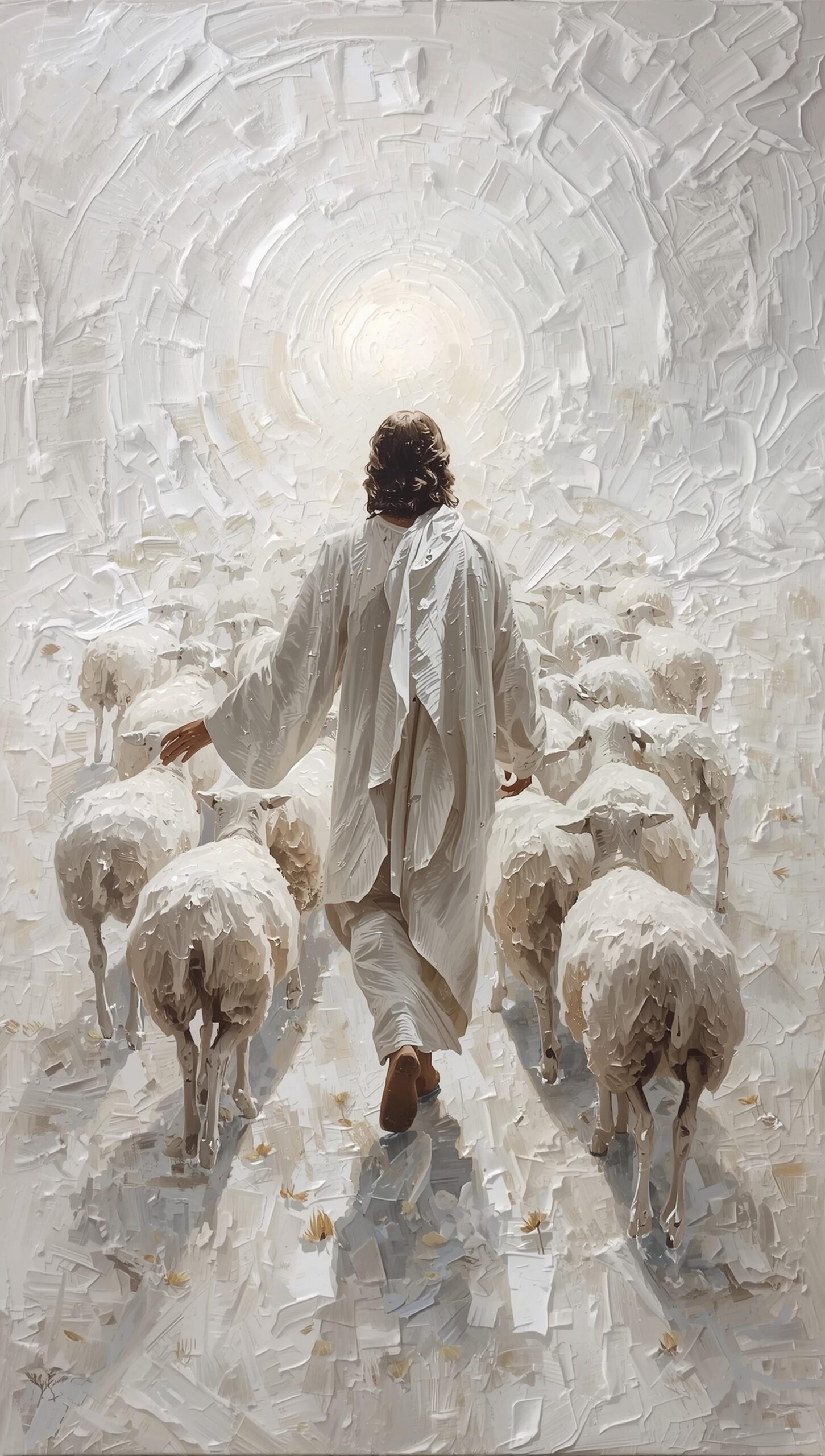
What does this picture teach? The shepherd among the sheep recalls the Lord’s charge to Peter: “Feed my sheep” (John 21:16). Jesus first asked Peter, “Lovest thou me?” The sheep are Christ’s, and caring for them is a responsibility given to one who loves Him. It is not a way of earning salvation. Love for the Saviour comes before service for the Saviour. A believer serves because he belongs to Christ—not so he can buy a place in God’s family.
The lesson is not that a Christian should do nothing until his love feels perfect. Rather, love for Christ should give direction to service. A pastor who teaches, a believer who helps someone in need, or a Christian who shares the gospel should not be seeking to purchase heaven or collect praise from people. We serve because we love the Saviour who first loved us (1 John 4:19).
“…and have not charity, it profiteth me nothing.”
1 Corinthians 13:3 · KJV (excerpt)
Paul even describes giving everything to feed the poor, then says that without charity it profits him nothing (1 Corinthians 13:1–3). The deed might still meet a real human need, but outward sacrifice does not replace love before God. Great activity does not automatically mean faithful service. God cares not only that something was done, but also about the spirit in which it was done.
Love is lived, not merely spoken.
Paul remembered the Thessalonians’ “work of faith, and labour of love, and patience of hope” (1 Thessalonians 1:3). Their work was connected with faith, their labour with love, and their endurance with hope in Christ. Their service had a spiritual source; it was not a way to buy salvation.
Think of ordinary Christian life. You read Scripture to know the Lord better. You pray because you can come to your Father. You gather with believers to learn and encourage one another. You obey because Christ’s words matter to you. You tell someone the gospel because that person needs to hear of the Saviour. These actions may express faith and love—but none of them replaces faith in Christ for eternal life.
Growth requires faithfulness over time. A young believer may stumble, misunderstand a passage, or fail to show love as he should. He should repent where needed, be corrected by Scripture, and keep growing. The pace or visible quantity of works is not a reliable human test by which we can pronounce someone saved or lost. Salvation is grounded in Christ’s promise; Christian conduct is a matter for instruction, obedience, and accountability.
First the Saviour. Then the service.
A person can perform religious activities without having believed on Jesus Christ. Attendance, charitable deeds, teaching, and outward devotion do not by themselves establish that anyone has become a child of God. Christian service in the sense discussed here belongs to the life of those who are in Christ.
Notice the audience before applying the rewards passage: First Corinthians was addressed to “the church of God which is at Corinth” (1 Corinthians 1:2), and 2 Corinthians likewise to the church and saints (2 Corinthians 1:1). Paul speaks to the saved about their walk and service. People may perform charitable or religious acts without knowing Christ, but such activity does not by itself make them children of God. Christ is the foundation; rewards do not purchase that foundation.
In 1 Corinthians 3:11–15, Paul discusses work built on the one foundation, Jesus Christ, in the context of Christian ministry. The work is tested; some work endures and receives reward, while other work is lost. Remarkably, verse 15 says of the man whose work is burned: “he himself shall be saved.” The passage distinguishes the worker’s standing from the outcome of his work.
Likewise, 2 Corinthians 5:10 teaches accountability at the judgment seat of Christ. In this discussion, rewards are not another offer of salvation to someone without Christ, nor are they the wages by which a believer finally buys eternal life. They concern service and its evaluation by Christ. This is why our companion lesson, Salvation & Rewards, matters: it explains the difference without mixing eternal life with reward for labour.
Do not think, “I must serve long enough to become saved.” Think instead, “Since Christ has saved me by grace through faith, how shall I now live for Him?”
Know whose child you are.
Grow in His Word.
Love Him.
Serve Him faithfully.
Salvation is not the reward for a life of service. Eternal life is God’s gift in Jesus Christ. Service, growth, and any rewards that Christ may give belong afterward. The foundation is always Christ—not our performance.
As you begin, take a small, faithful step: read a passage, pray, seek a sound local church, and ask how you may serve others in love. Do it because you have trusted the Saviour, never as a way to complete what Christ has already accomplished.
Explore these subjects more deeply. Let Scripture guide the distinction between eternal life, Christian living, and reward.
BIBLICALIST · END OF NEW BELIEVERS GUIDE